Designed for use rather than for ostentation by Nathan Jones

I post this extended quotation from Gibbon for the pure enjoyment of 18th Century English prose. Our current use of the language is horribly impoverished by comparison.

The family of Gordianus was one of the most illustrious of the Roman senate. On the father’s side, he was descended from the Gracchi; on his mother’s, from the emperor Trajan. A great estate enabled him to support the dignity of his birth, and, in the enjoyment of it, he displayed an elegant taste and beneficent disposition. The palace in Rome, formerly inhabited by the great Pompey, had been, during several generations, in the possession of Gordian’s family. It was distinguished by ancient trophies of naval victories, and decorated with the works of modern painting. His villa on the road to Preneste, was celebrated for baths of singular beauty and extent, for three stately rooms of an hundred feet in length, and for a magnificent portico, supported by two hundred columns of the four most curious and costly sorts of marble. The public shows exhibited at his expense, and in which the people were entertained with many hundreds of wild beasts and gladiators, seem to surpass the fortune of a subject; and whilst the liberality of other magistrates was confined to a few solemn festivals in Rome, the magnificence of Gordian was repeated, when he was ædile,
every month in the year, and extended, during his consulship, to the principal cities of Italy. He was twice elevated to the last mentioned dignity, by Caracalla and by Alexander; for he possessed the uncommon talent of acquiring the esteem of virtuous princes, without alarming the jealousy of tyrants. His long life was innocently spent in the study of letters and the peaceful honours of Rome; and, till he was named proconsul of Africa by the voice of the senate and the approbation of Alexander, he appears prudently to have declined the command of armies and the government of provinces. As long as that emperor lived, Africa was happy under the administration of his worthy representative; after the barbarous Maximin had usurped the throne, Gordianus alleviated the miseries which he was unable to prevent. When he reluctantly accepted the purple, he was above fourscore years old; a last and valuable remains of the happy age of the Antonines, whose virtues he revived in his own conduct, and celebrated in an elegant poem of thirty books. With the venerable proconsul, his son, who had accompanied him into Africa as his lieutenant, was likewise declared emperor. His manners were less pure, but his character was equally amiable with that of his father. Twenty-two acknowledged concubines, and a library of sixty-two thousand volumes, attested the variety of his inclinations; and from the productions which he left behind him, it appears that the former as well as the latter were designed for use rather than for ostentation.
— Edward Gibbon in The Decline and Fall of the Roman Empire (1776)

On the relationship between openness and religiosity by Nathan Jones

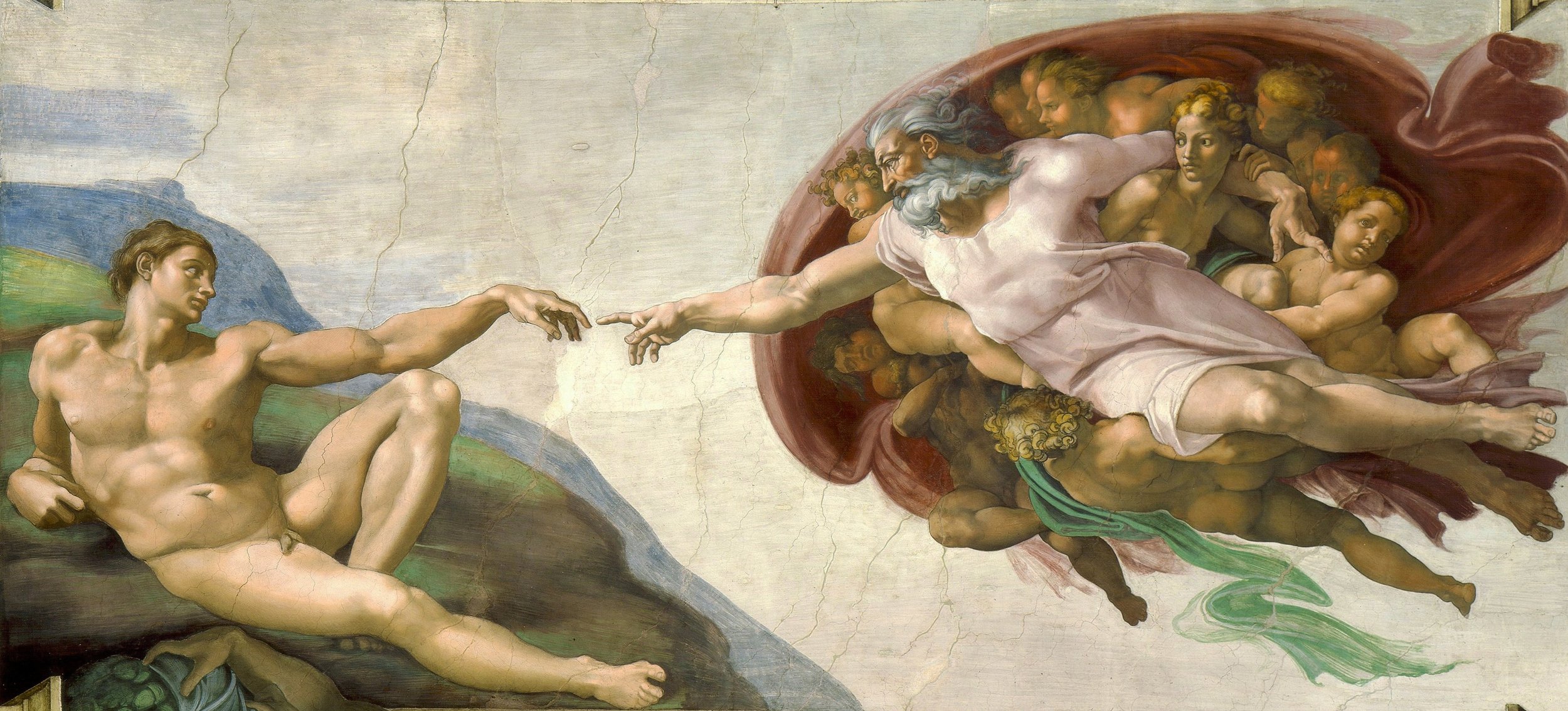
The "Creation of Adam" by Michaelangelo

In today's irreligious North American society, is the personality trait of openness to experience more strongly associated with belief and observance than it was in earlier, more religious ages? When the Christian ethos permeated society, a life of traditional religiosity–a life of faith–may have been associated with low openness. Now that these ideas and values have been pushed to the margin, to adopt them as a worldview requires a psychological liberalism, a challenge to authority, and an aesthetic sensibility that would not have been necessary in ages past. Present-day closed-mindedness seems to me to be better correlated with dogmatic adherence to the scientific-materialist worldview than it is to the worldview of revealed religion, which appears richer, thicker, and more engaging of the imagination.

Costa and McCrae propose six facets of openness to experience: fantasy, aesthetics, feelings, actions, ideas, and values (all of which are consistent with a traditional religious faith, particularly fantasy, aesthetics, and values.)

It's nothing personal by Nathan Jones

The enemy is anyone who questions liberalism, globalism, individualism, nominalism in all their manifestations. This is the new ethic of liberalism. It’s nothing personal. Everyone has the right to be liberal, but no one has the right to be anything else.
— Aleksandr Dugin in The Great Awakening vs. the Great Reset (2021)

Drive: A love story by Nathan Jones

Drive (2011) directed by Nicolas Winding Refn, starring Ryan Gosling and Carey Mulligan. The frames are taken from Driver and Irene’s courtship, which is by far my favourite part of the movie (before the violence begins). The dialog is spare and the love between the characters unfolds slowly and powerfully in a sequence of simple scenes rendered by achingly beautiful cinematography set against a perfect electronic score. The exquisite innocence of the romance blossoms amidst the dread of upcoming calamity.

What you should have resisted at the time by Nathan Jones

You may be tempted to take stock, to wrestle with the past. There is nothing wrong with that. But do not make a further mistake, the mistake of stepping back, abstracting from the details of your life, to ask what you should want. In abstracting, you discard a vital source of rational affirmation: not the bare existence of activities, artifacts, relationships, but their impossibly verdant depths. Do not weigh alternatives theoretically, but zoom in: let the specifics count against the grand cartoon of lives unlived. In doing so, you may find you cannot regret what you should have resisted at the time.
— Kieran Setiya in Midlife: A Philosophical Guide (2017)